

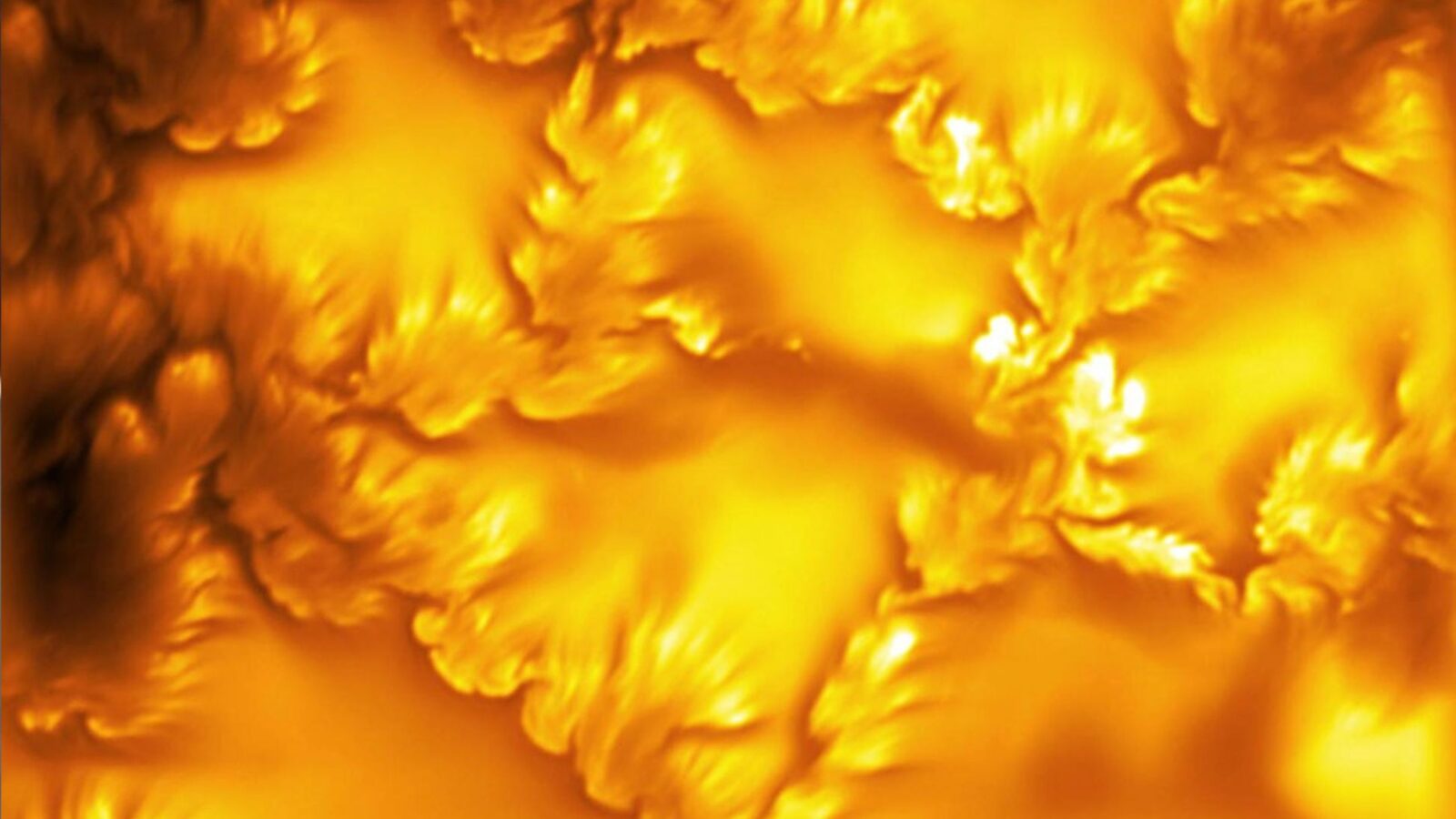
The sharpest image of the Sun ever recorded has allowed scientists to observe a phenomenon that had been predicted for more than a century but never directly seen. Captured in visible light, the photograph reveals tiny plasma vortices swirling across the surface of our nearest star.
These structures had long been theorised in solar physics, yet the level of detail required to detect them had remained beyond reach until now. The new image demonstrates just how far observational capabilities have advanced, offering researchers a fresh perspective on the behaviour of solar plasma.
What the New Image Shows
The photograph was taken in visible light, making it possible to observe the small-scale plasma vortices for the first time. Their existence had been anticipated for over a hundred years, but confirming them visually required an exceptional level of clarity and resolution.
Plasma, the superheated and electrically charged gas that makes up the Sun, moves in complex patterns across its surface. The ability to capture these fine details marks a significant step in the study of how the Sun’s outer layers behave and interact.
Why This Discovery Matters
Observing these tiny vortices directly provides scientists with valuable information that was previously available only through theoretical models. Turning a long-standing prediction into a confirmed observation allows researchers to refine their understanding of solar dynamics.
The image stands as a milestone in solar observation, demonstrating the precision now achievable when studying the Sun. For the first time, a phenomenon anticipated for generations has been made visible, offering a clearer view of the processes shaping the surface of the star at the centre of our solar system.