

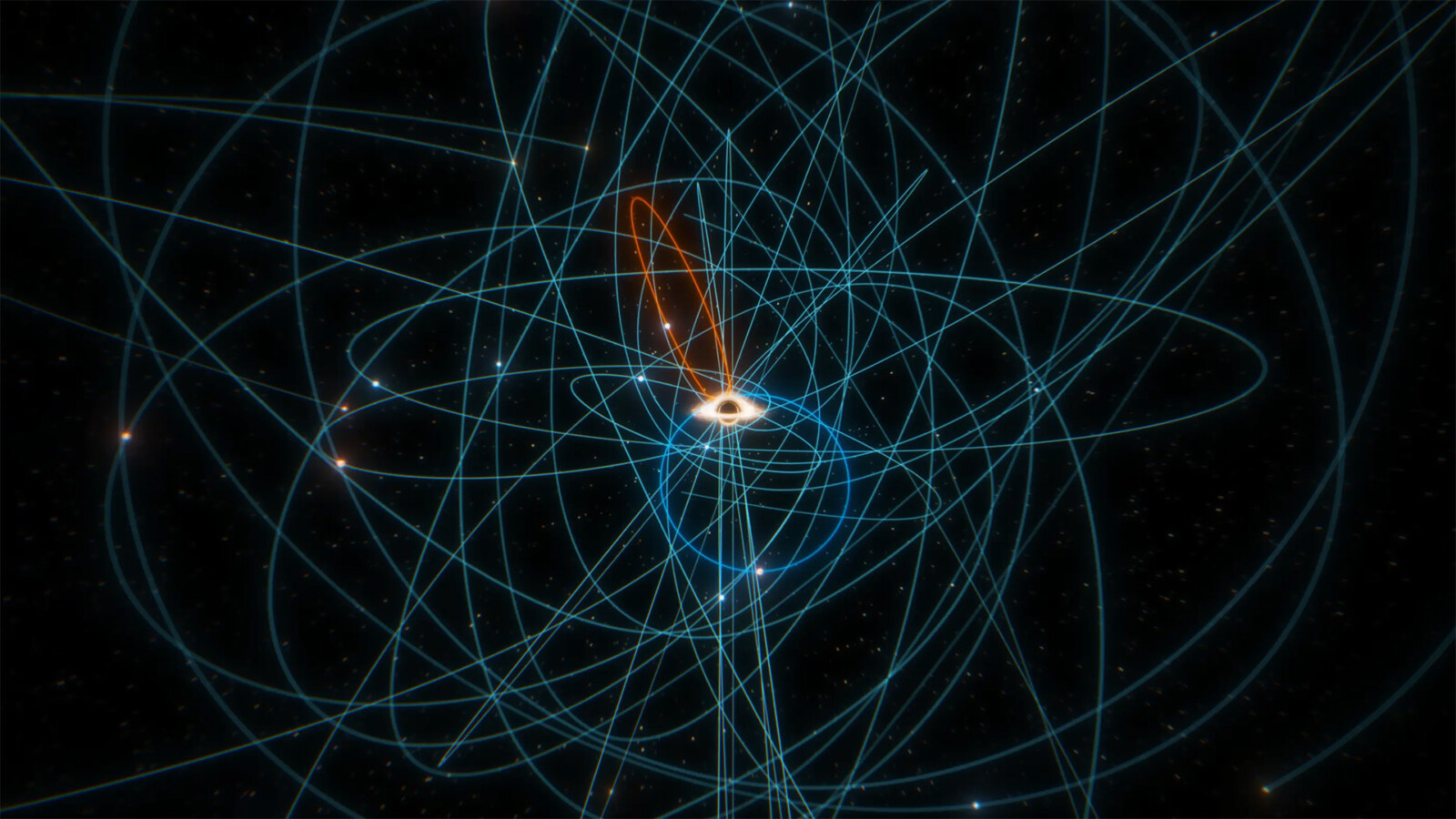
S301 is a newly identified star near the centre of our galaxy that moves faster than any other celestial object observed by science. Located close to the heart of the Milky Way, it has drawn attention for the extraordinary speed at which it circles Sagittarius A, the supermassive black hole at the galaxy’s core.
The star was identified by researchers at the Max Planck Institute for Extraterrestrial Physics in Germany. It joins a catalogue of more than 1.8 billion stars, but its properties set it apart. Chief among them is its remarkable pace: S301 reaches a peak speed of roughly 15,500 miles per second, equivalent to about 55.8 million miles per hour.
A Record-Breaking Velocity
The star accelerates dramatically as it approaches Sagittarius A, hitting that peak velocity as it makes a sharp turn around the black hole. It then slows as it swings out along a much wider loop before repeating its orbit.
To put that speed in context, the previous record-holder for the fastest celestial object was a low-mass star and its accompanying super-Neptune planet, travelling at roughly 1.2 million miles per hour, or about 333 miles per second. Our solar system moves through space at around 500,000 miles per hour, approximately 140 miles per second, while the fastest human-made object ever built, the Parker Solar Probe, travels at 430,000 miles per hour.
Even so, S301 remains far below the speed of light, measured at 186,282 miles per second, and slower than phenomena such as gravitational waves and black hole jets. Nonetheless, it outpaces every other planet or star humans have observed.
Aiding Black Hole Research
S301’s other notable quality is its proximity to Sagittarius A. It orbits ten times closer to the black hole than the previous nearest known star, S2. Researchers regard this closeness as the star’s true scientific value, because it experiences the black hole’s effects far more acutely than anything else known.
Studying black holes is exceptionally difficult. Their gravity is so intense that nothing can escape, not even light, so scientists must measure the effects a black hole exerts on surrounding objects. The first image of a black hole illustrates this: the black hole itself cannot be seen, only the accretion disc formed around it.
Researchers at the Max Planck Institute have already detected and measured some of these effects on S301. They intend to observe the star over the coming decade, hoping the data will offer fresh insights into how black holes behave. Because S301 sits so close to Sagittarius A, researchers can test theories that were previously beyond reach, as no other known object came near enough to feel these effects.