

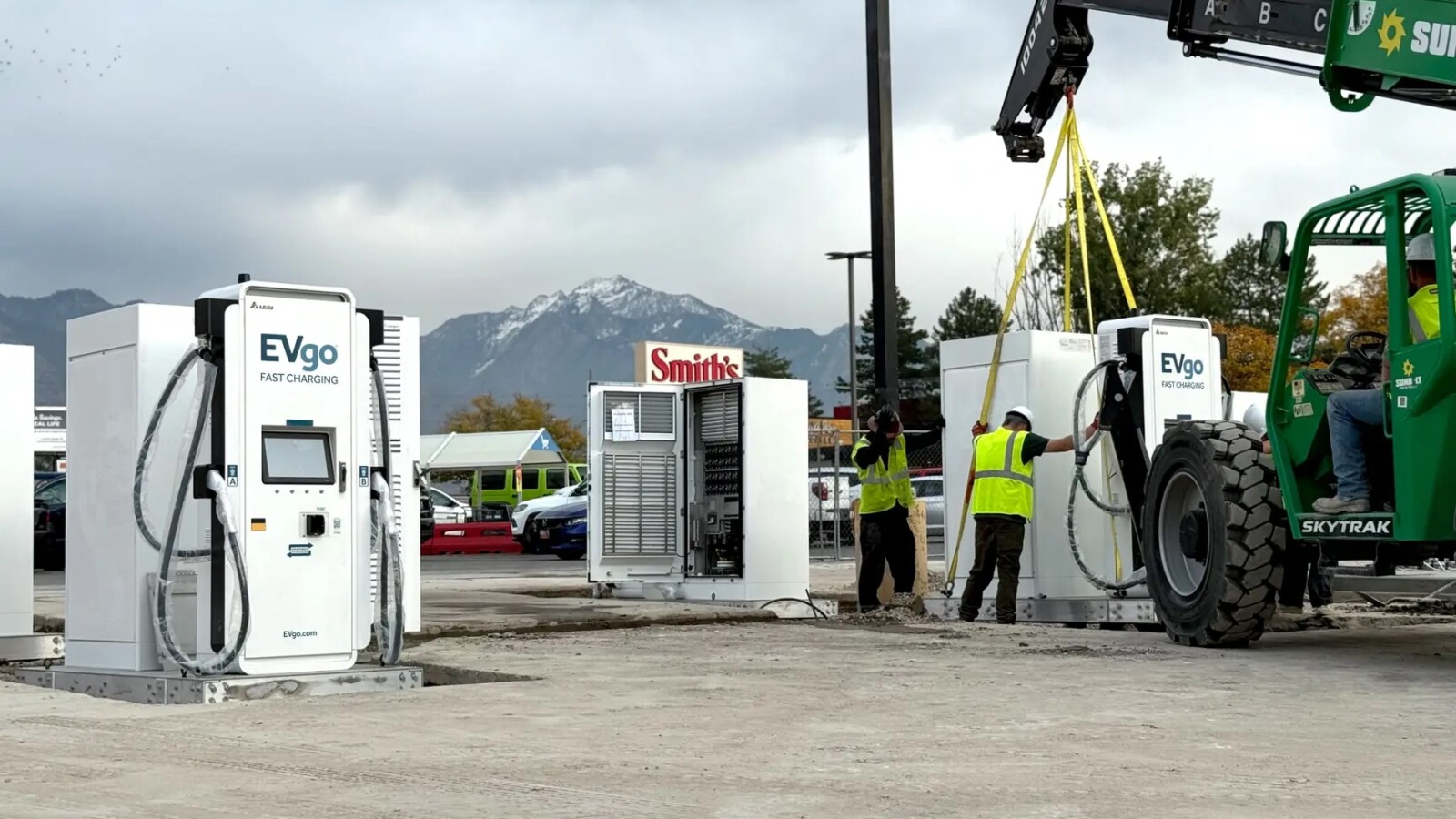
EVgo’s next-generation 750-kilowatt EV charging system has been announced this week, promising speeds nearly double those of the fastest public chargers currently available in the US and Europe. Compatible next-generation electric vehicles could recharge in as little as 10 minutes, with the technology expected to be fully revealed in 2027.
EVgo is not alone in pushing charging performance forward. Earlier this year, ChargePoint launched its Express Solo DC fast-charging station, capable of delivering 600 kW of power. Chinese manufacturers such as BYD, alongside European automakers and charging technology companies, are prototyping and deploying liquid-cooled Megawatt Piles said to recharge compatible EVs in five minutes or less. Beyond making pit stops more convenient, future high-speed charging also holds potential for fully electric heavy trucks and electric air mobility.
How the new 750kW stations work
The new charging system will use the North American Charging Standard (NACS), pioneered by Tesla and adopted by most upcoming North American EVs. EVgo describes the move as part of a strategy to double the effective reach of its network by welcoming NACS drivers without requiring an adapter. The thousands of EVs on the road fitted with a CCS plug, however, will still need to adapt.
The stated 750 kW maximum is the station’s theoretical top speed, intended for future EVs capable of accepting that much power. On average, the fastest-charging EVs on the road today can only take up to 350 kW, with actual charging speed determined by battery condition, temperature and state of charge. Many models are capable of only around 150 kW.
Most EVs also ramp up to their optimal speed and then slow down as they approach full capacity to protect the battery, so they remain limited to their specific maximum speed and charging curve. It may be some time before cars capable of a 10-minute recharge reach the road.
More robust and more reliable hardware
The new stations will feature an updated cable design that is easier to manoeuvre, along with a touchless payment interface. Dynamic power sharing is built into the specification, meaning the available charge rate is distributed between connected EVs. The chargers will also use more robust hardware and software, which should improve reliability.
EVgo currently operates more than 1,200 fast charging locations across the US and states that it is one of the only American charging networks to design its own chargers. The company is designing and testing the next-generation charging system at its laboratory in El Segundo, California, with co-development support from partner Delta Electronics. The final charger design is expected to be unveiled in 2027 as EVgo begins deploying the new architecture.