
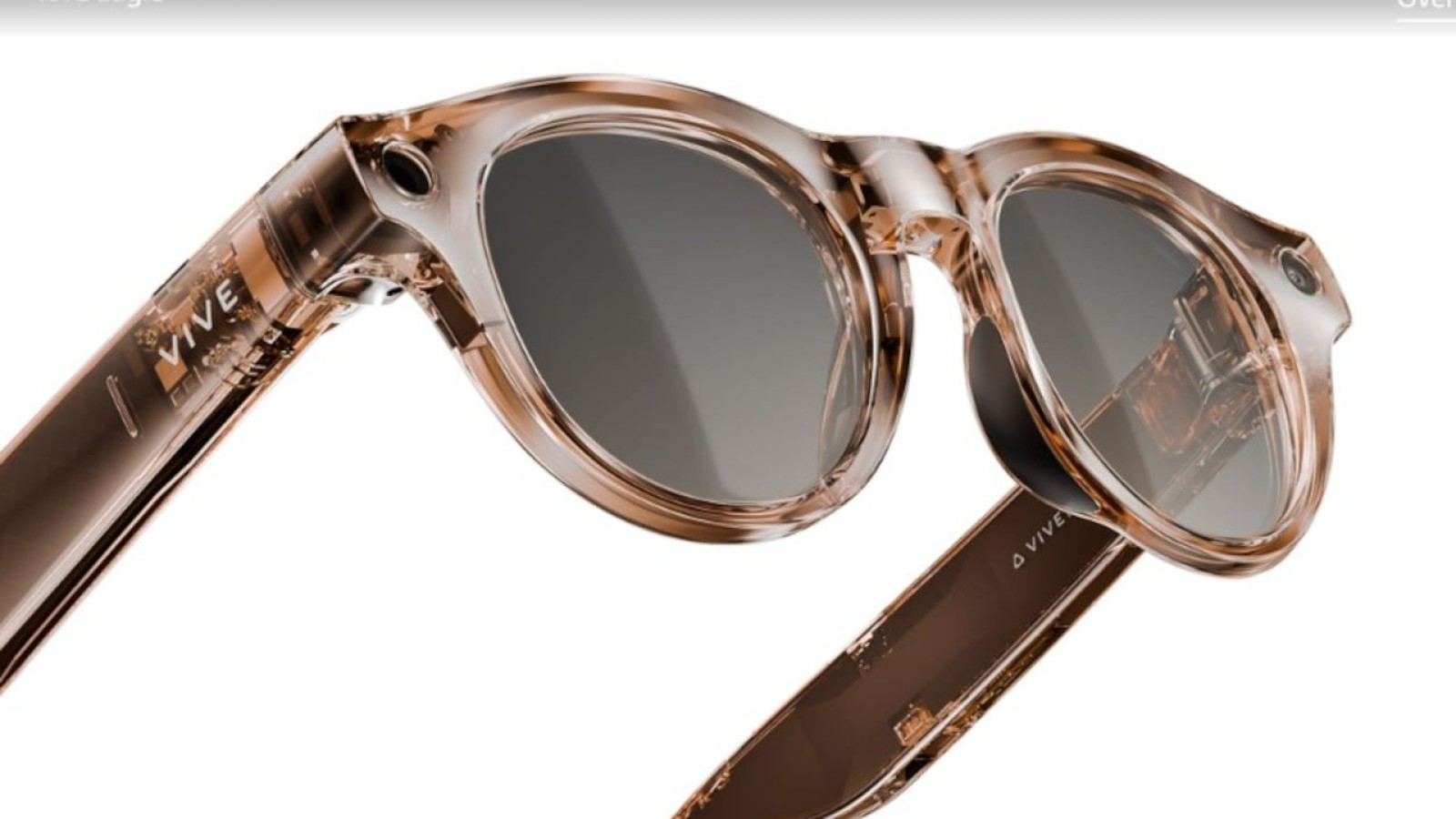
HTC VIVE Eagle smart glasses have gone on sale, giving buyers a wearable that supports two competing artificial intelligence ecosystems. Priced at £395, the glasses let users choose between Google’s Gemini and OpenAI’s ChatGPT, placing HTC directly against the established players in a rapidly expanding category.
The device is offered in two frame styles. One adopts the familiar Wayfarer silhouette, available in Black, Coffee and Berry. The other uses the classic Pantos shape, distinguished by a rounded lens with a flatter top rim, and comes in Charcoal Black, Clear Brown and Navy.
Pricing and rivals in the AI glasses market
At £395, the HTC glasses sit slightly above the £365 Ray-Ban Meta Wayfarer Gen 2, their closest direct competitor. HTC is securing an early position ahead of Google and Samsung, which are preparing audio-only AI glasses, while Apple is expected to ship its first pair next year.
The market is becoming more crowded still. Snap plans to release AR-powered glasses that project computer-generated imagery over the wearer’s real-world view. Those are a more complex proposition, priced at around £1,735, with a reservation deposit of roughly £160.
Interest in the VIVE Eagle grew earlier when a pre-order page briefly appeared on Amazon before being removed. That listing referenced a September release window, which proved close to the eventual launch date.
Camera privacy and hardware specifications
The VIVE Eagle tackles a common concern surrounding smart glasses: being recorded without warning. An LED indicator lights up whenever the camera is active, signalling to nearby people that video or photographs are being captured.
Among the highlighted features are AI image translation and audio translation delivered through open-ear speakers while in Listening Mode. The glasses run on the Qualcomm Snapdragon AR1 Gen 1 processor and include a 12MP ultra-wide camera, 4GB of RAM and 32GB of storage.
Power comes from a 235mAh battery rated for 36 hours of standby time, up to 4.5 hours of continuous music playback and more than three hours of continuous voice calls. Using the magnetic charging cable, Fast Charge takes the battery from 1% to 50% in 10 minutes, or from 1% to 80% in 23 minutes.
The wearable is compatible with an iPhone running iOS 17.6 or higher, as well as Android devices.
Source
Image: phonearena.com