

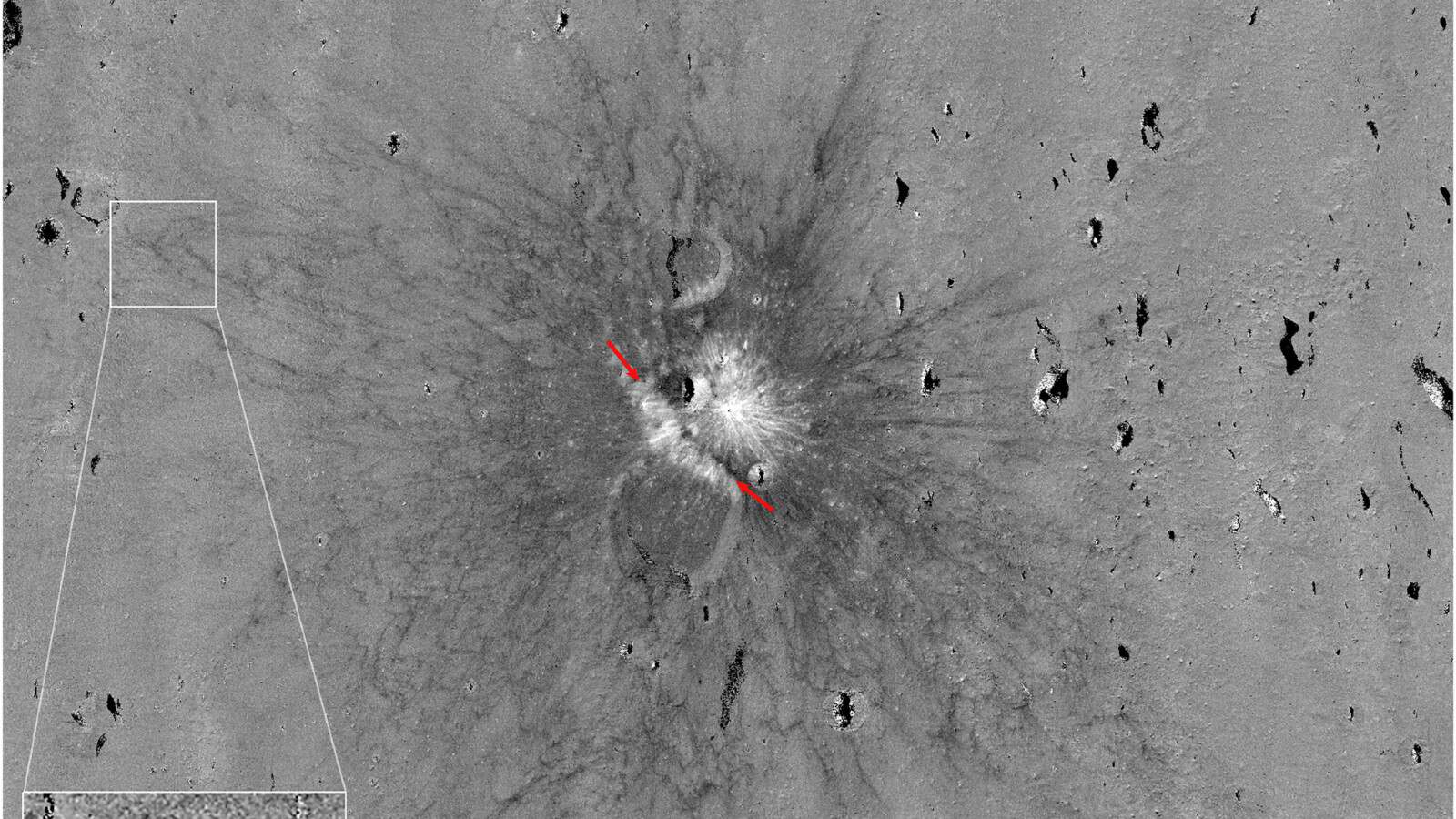
NASA has confirmed the discovery of a substantial new crater on the Moon, spotted during a routine data-quality check by scientist Robert Wagner. The find, published in Science Advances, has been named the biggest new crater ever detected by NASA’s Lunar Reconnaissance Orbiter (LRO).
Although the crater was identified in 2026, the impact that created it is thought to have occurred earlier, likely between 11 April 2024 and 22 May 2024. The object responsible for the collision was estimated to be roughly the size of a six-storey building. Wagner described his reaction to noticing the anomaly, saying he “just stopped, dropped everything, and started looking into what that spot was.”
A Rare Impact on the Lunar Surface
The Moon carries more than 2 million craters across its surface, yet the overwhelming majority of the larger examples formed long before humans began observing it. That rarity makes any fresh, sizeable crater notable. This one measures 728 feet across, more than twice the width of a football field, and reaches a depth of 141 feet.
According to modelling referenced in the study, an impact of this magnitude is expected to occur only once every 132 years on the Moon. Wagner described the event as a statistically rare, effectively once-in-a-lifetime observation. The crater has been named McGetchin, in honour of Tom McGetchin, who became director of the Lunar Science Institute in 1977, shortly before his death in 1979.
How the Orbiter Tracks Lunar Changes
The LRO scans the entire lunar surface once every 14 days, providing a steady stream of new data. Because the Moon has no atmosphere, its pockmarked surface remains largely intact until another asteroid or meteor strikes. Over its 17 years in service, the orbiter has identified approximately 1,000 new impact craters and more than 100,000 other changes to the Moon’s surface.
The satellite can detect craters only around 30 feet wide or larger, which means many smaller impacts go virtually unnoticed. As a result, the full number of changes to the lunar surface remains uncertain.
The discovery caps a busy period for the Moon, which received human visitors for the first time in 50 years through the Artemis II mission, before an abandoned SpaceX rocket crash-landed into it. That collision left a crater substantially smaller than the McGetchin crater identified by Wagner.