

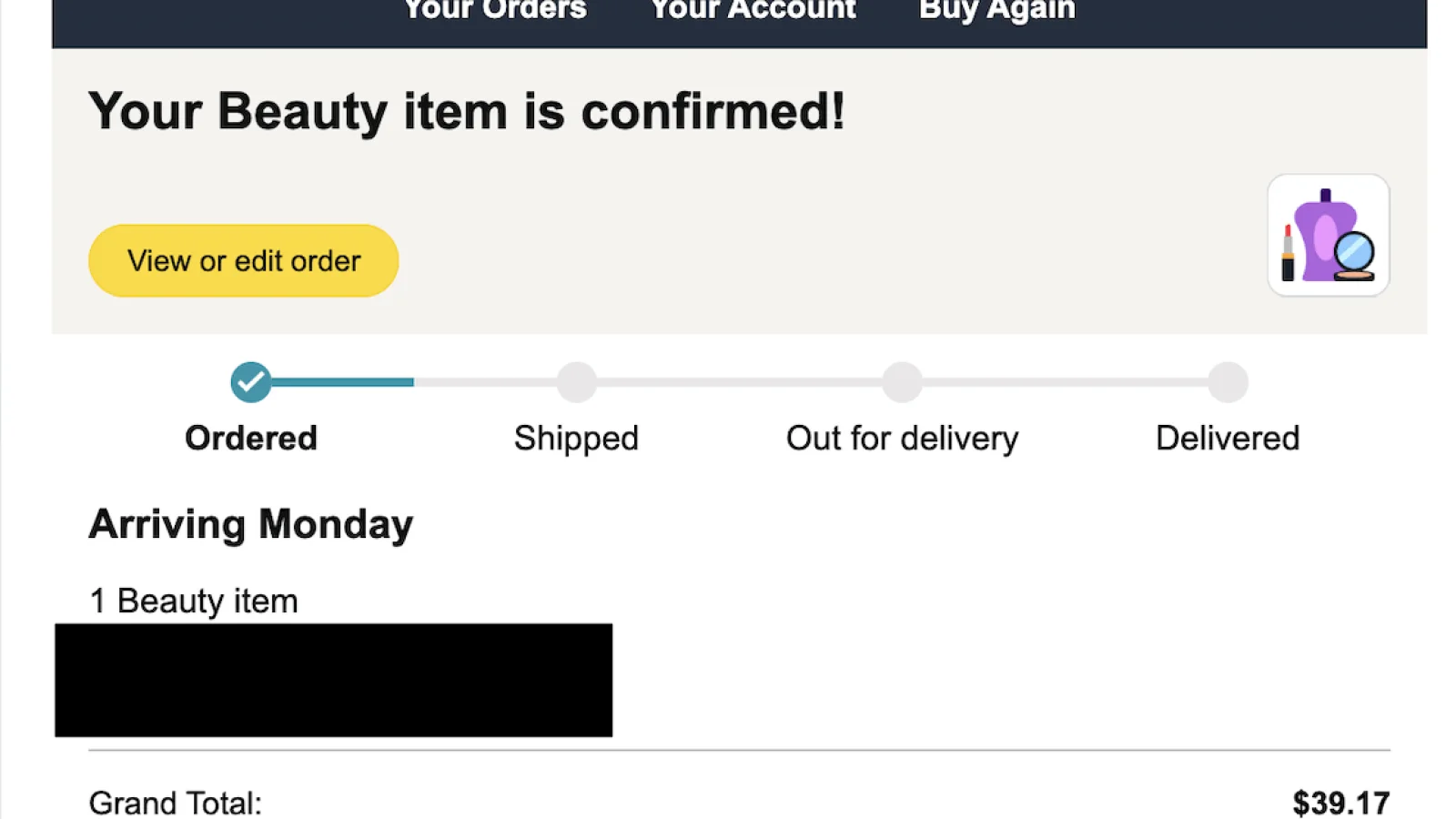
Amazon order confirmation emails have grown noticeably less helpful for shoppers, with many customers reporting that recent notifications no longer name the specific products they bought. Instead, the emails now display only broad item categories, leaving buyers to open the Amazon app or website to check exactly what they purchased.
The change appears to have begun in July, when shoppers started receiving stripped-back messages such as “Your Beauty item is confirmed!”, “Ordered: 1 Hardware item”, and “1 Nutrition & Wellness, 1 Wireless Accessories”. The revamped emails include clip art-style illustrations representing general product groups rather than thumbnails and names of the exact items. Orders placed as recently as June still contained detailed product information, suggesting the shift is recent.
Why shoppers are frustrated
A growing number of customers have complained to Amazon that the vague messages make it harder to keep track of their purchases. Some have noted that the notifications resemble spam or phishing attempts, given the lack of concrete order details. Amazon has adjusted the appearance of its order emails many times over the years, prompting recurring complaints about what information is and is not included, but the latest round of changes has drawn fresh attention over the past month and a half.
Artificial intelligence is likely partly responsible for the shift. Over the past year, technology companies have promoted a future in which AI agents handle tasks for consumers, including making purchases on their behalf. These agents typically depend on access to personal data, including information found in a user’s inbox, to function effectively.
Protecting the customer relationship
Google is well placed to advance this vision, drawing on a catalogue of billions of products in Shopping and a range of AI-powered features. Its Gemini Spark tool can extract information from a user’s email to build custom outputs such as holiday itineraries, pulling in data like ticket confirmations. In May, Google unveiled a shopping cart that works across multiple merchants and is set to be integrated into Gmail, allowing shoppers to add items while reading their inbox or watching YouTube.
Major retailers including Walmart, Target and Wayfair have signed up to commerce features built into Google’s AI surfaces, hoping consumers will research, compare and buy through chatbots. Amazon is notably absent from that list, having taken a more protective stance over its direct relationship with shoppers. Last year the company sued Perplexity for allowing users to shop on Amazon on their behalf, though a judge sided with Perplexity earlier this month.
Amazon has been developing its own AI shopping tools, including price tracking and automatic purchasing. Its Alexa for Shopping feature is built into the Amazon app, letting shoppers query the chatbot for product recommendations and comparisons.
Source
Image: theverge.com