

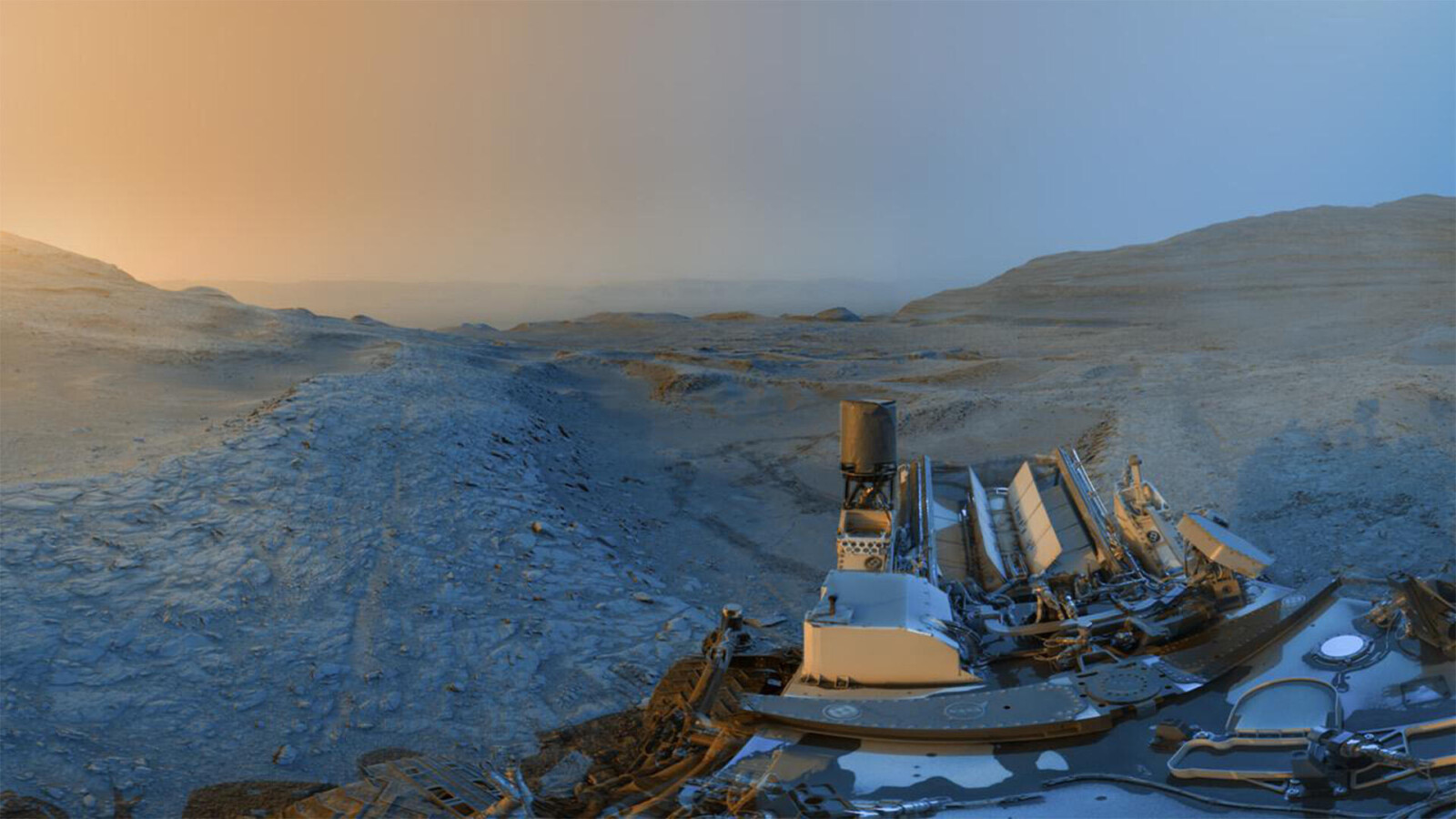
Building homes on Mars may one day rely on an unexpected combination of sand, gelatin and yeast, according to a study published on 10 September in the journal Chem Circularity. Researchers have devised a method that transforms Martian sand into a material functionally equivalent to low-grade concrete, using the planet’s own harsh environment as part of the manufacturing process.
The approach combines three main components: ordinary porcine gelatin, the same substance used to make jiggly desserts; a specially engineered yeast coated in the proteins that mussels use to cling to rocks; and pounded-up Martian rock mixed with water. When brought together, the dry, cold and low-pressure conditions on the red planet freeze-dry the mixture, producing a porous, foam-like material sturdy enough to form the basis of living quarters.
Senior author Jishen Qiu of The Hong Kong University of Science and Technology traced the concept back to a familiar source. “My inspiration came from freeze-dried fruits that become harder,” he said. “So, I asked myself if we can take advantage of that and make some materials.”
How the Martian Concrete Performs
The resulting Martian concrete measures between 10 and 12 megapascals, a level of strength comparable to low-grade concrete used on Earth. That is sufficient to support a one- or two-storey house on Earth, and because Mars has roughly a third of Earth’s gravity, the material offers ample strength for structures on the red planet.
The freeze-drying effect works because the frigid, low-pressure Martian environment causes the water in the mixture to sublimate, turning directly from a solid into a vapour and leaving the concrete behind. The process happens so quickly that objects must be 3D-printed in real time for it to function correctly.
Testing and Reuse Potential
To demonstrate the method, the team 3D-printed two small beehive-shaped structures, each about the size of a wine cork, within a simulated Martian environment. Homes built this way would resemble beehives while being made of what is essentially concrete. The researchers believe the process can be scaled up for larger construction.
A notable feature of the technique is its potential for reuse. Once a structure has reached the end of its usefulness, inhabitants could break it down, mix the material in a bioreactor and brew an entirely new building from the same components, provided living yeast remains available to reproduce.
Housing remains one of the central obstacles to establishing a human presence on Mars. Beyond the challenge of transporting people there, any settlers would require shelter capable of withstanding the planet’s extreme conditions, including temperature swings of nearly 100 degrees Celsius and minimal protection from solar radiation owing to the thin Martian atmosphere. Proposed solutions have ranged from inflatable dwellings to self-propagating fungi grown into entire buildings. The tested beehive-shaped structures measured roughly the size of a wine cork.