
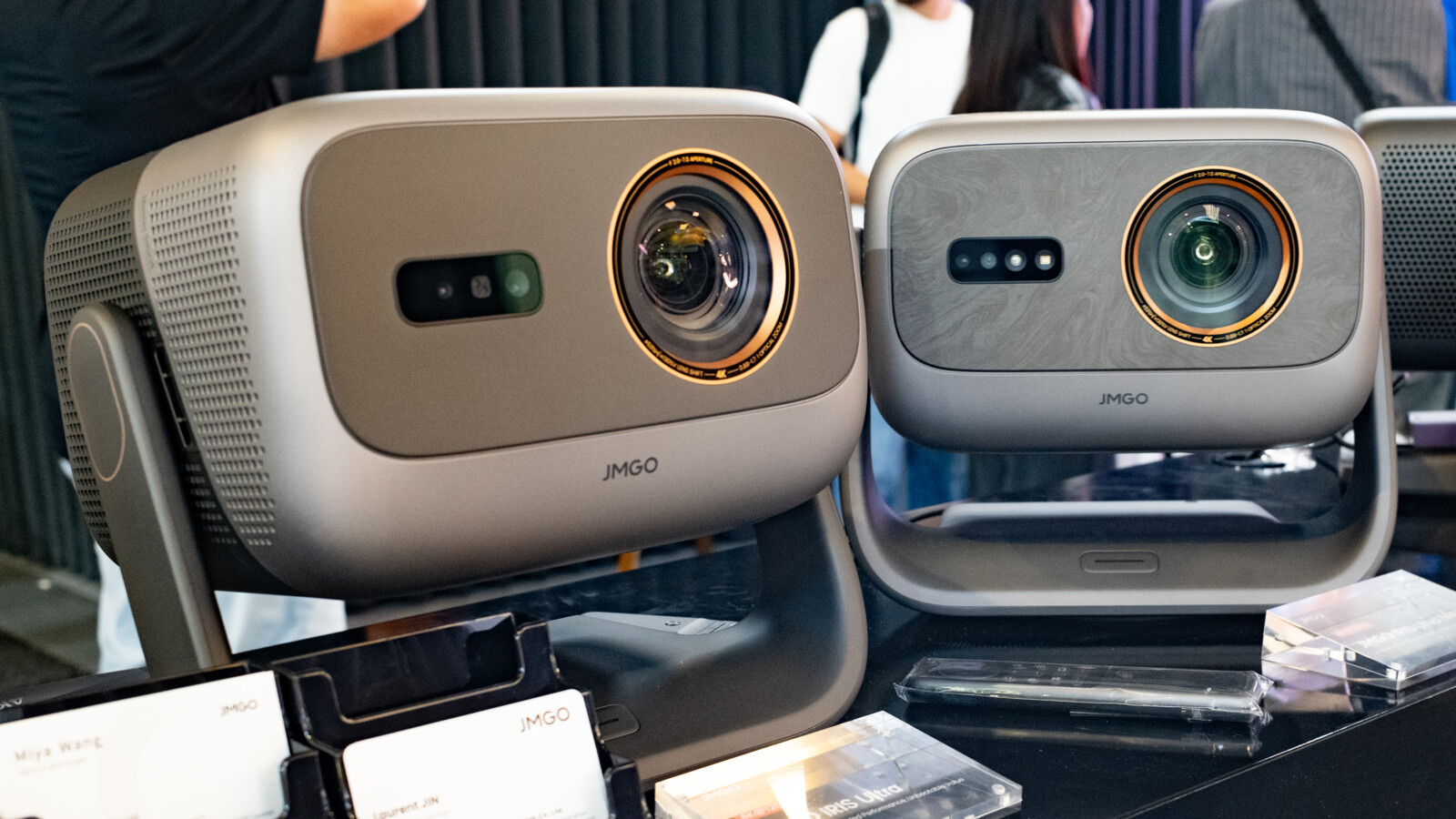
JMGO has unveiled its new Iris range of projectors at the IFA show in Berlin, headlined by a 120Hz refresh rate running at full 4K resolution. While the exterior closely resembles the N3 Ultimate and other gimbal projectors in the manufacturer’s catalogue, the Iris models house a new light engine promising greater brightness alongside that faster refresh.
A 120Hz refresh rate is not entirely new to projectors, and it has long been standard on televisions. However, in projectors that refresh rate has historically been limited to 1080p resolution. Achieving it at 4K represents a notable technical step, even if the practical benefit for most viewers may be modest. It does, nonetheless, illustrate the direction in which projector technology is heading.
Two Models: Iris Ultra and Iris Ultra Max
The Iris line comprises two models. The Iris Ultra Max claims 6,500 lumens, a fully motorised gimbal and a higher native contrast ratio. The more affordable Iris Ultra offers 4,500 lumens and manual gimbal adjustments only. Both models feature a 0.9-1.7:1 optical zoom as well as horizontal and vertical image shift, which operates separately from the gimbal. A dual iris system is also included to help fine-tune brightness and improve the dynamic contrast ratio.
At the show, JMGO set up a side-by-side demonstration running fast-moving, fast-panning 60-frames-per-second content. One projector ran at 60Hz and the other at 120Hz, with the latter showing less blur on parts of the image. For content that is not native 60fps, such as sport or video games, higher-refresh projectors of this kind can introduce motion-smoothing artefacts, commonly known as the soap opera effect. Because 120Hz is an even multiple of 24, it is theoretically possible to remove judder without interpolating frames.
Refresh Rate and the Rainbow Effect
DLP technology has never had a significant problem with motion blur, so a faster refresh delivers less dramatic improvement than it would on an LCD panel. Reducing LCD motion blur was the original reason televisions adopted faster refresh rates. JMGO states that the faster refresh can also help minimise DLP’s rainbow effect, in which some viewers notice rainbow trails around certain on-screen objects or when moving their eyes. That could prove genuinely useful for those who are susceptible to the issue.
The Iris projectors succeed the N3 Ultimate, previously regarded as a leading gimbal projector. With image shift and optical zoom, such models can fit into a wide range of rooms regardless of how much the gimbal mechanism itself is used. The key question for the Iris range will be whether JMGO can maintain that image quality while increasing brightness and adding the new 120Hz capability at 4K resolution.