
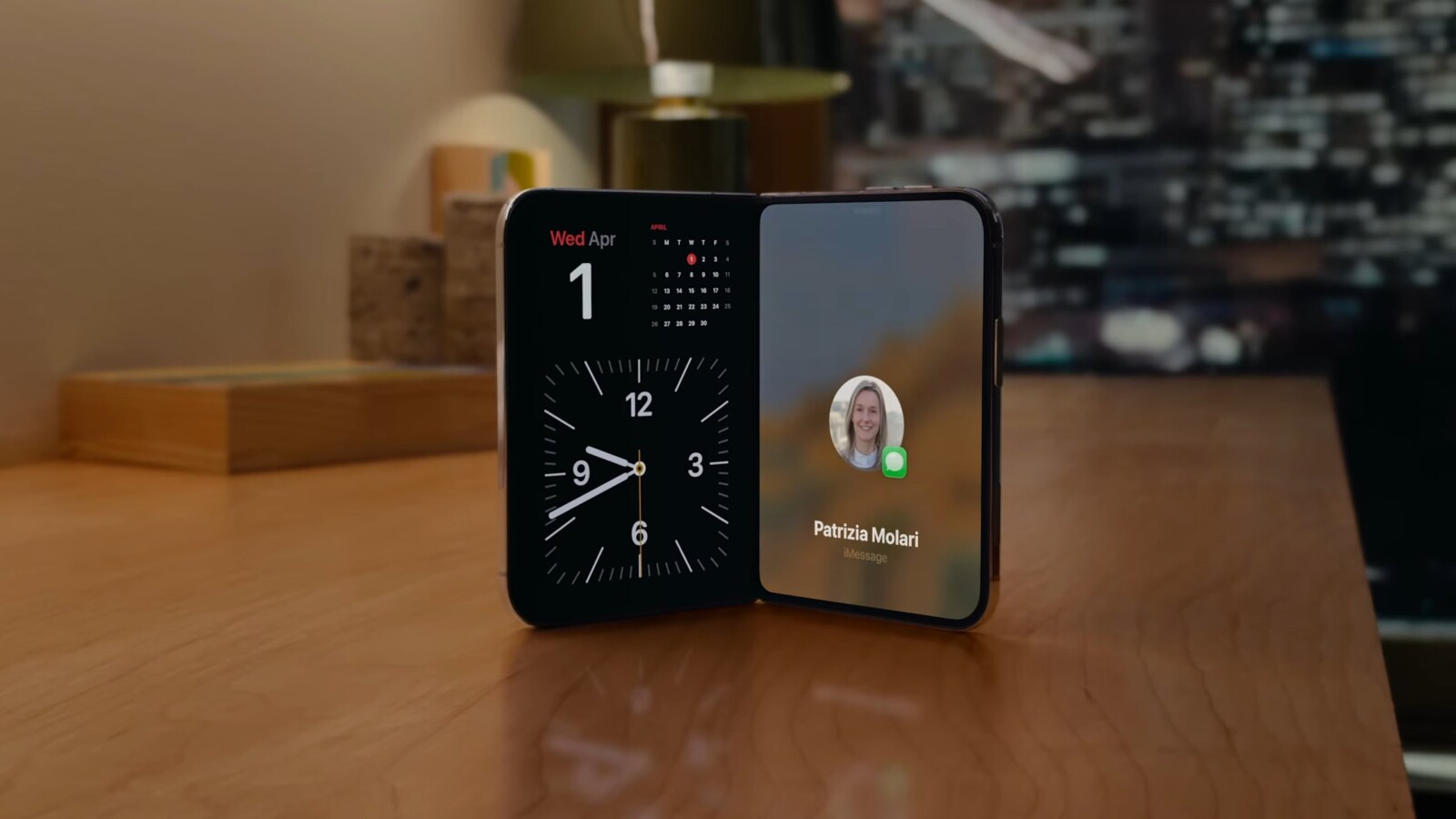
The foldable iPhone Duo has arrived, and Apple has employed a clever technique to make its internal display appear crisp and flat. Yet the solution the company chose means that one element really stands out on an otherwise stunning screen: the camera.
The iPhone Duo’s under-display camera
The main internal display on the iPhone Duo features an under-display camera, an approach Samsung abandoned with the Galaxy Z Fold 7. In most cases, this creates a more uniform viewing experience, but the camera becomes noticeable under certain lighting conditions.
The under-display camera also carries a trade-off, being slightly worse at photography and videography compared with a standard punch-hole camera. Early hands-on reports suggest the camera becomes far more visible when the display is held under direct light, to the point where it can be almost as distracting as a traditional punch-hole cut-out.
Why the glare appears
The explanation is straightforward. Apple has applied a nano-texture coating to the main display, giving it a slightly matte finish. This helps the internal screen look exceptionally clear, as the coating disperses most harsh lighting, reflections, and glare. Many people also agree that such a display is effective at hiding the crease, which is perhaps the biggest reason Apple opted for this coating.
However, the coating could not be applied over the opening of the under-display camera. Doing so would have drastically reduced the quality of the photos and videos it can capture. As a result, whenever glare passes across the display, it is dispersed over most of the surface before hitting the small patch where it is not cancelled out. This is why the under-display camera reflects light so brightly while the rest of the screen remains far less distracting.
Looking ahead
The use of an under-display camera on the iPhone Duo has fuelled speculation about the alleged iPhone 20 Pro and its rumoured all-glass design. If Apple is deploying an under-display camera now, it could do so again for the 20th anniversary of the iPhone.
Source
Image: phonearena.com