

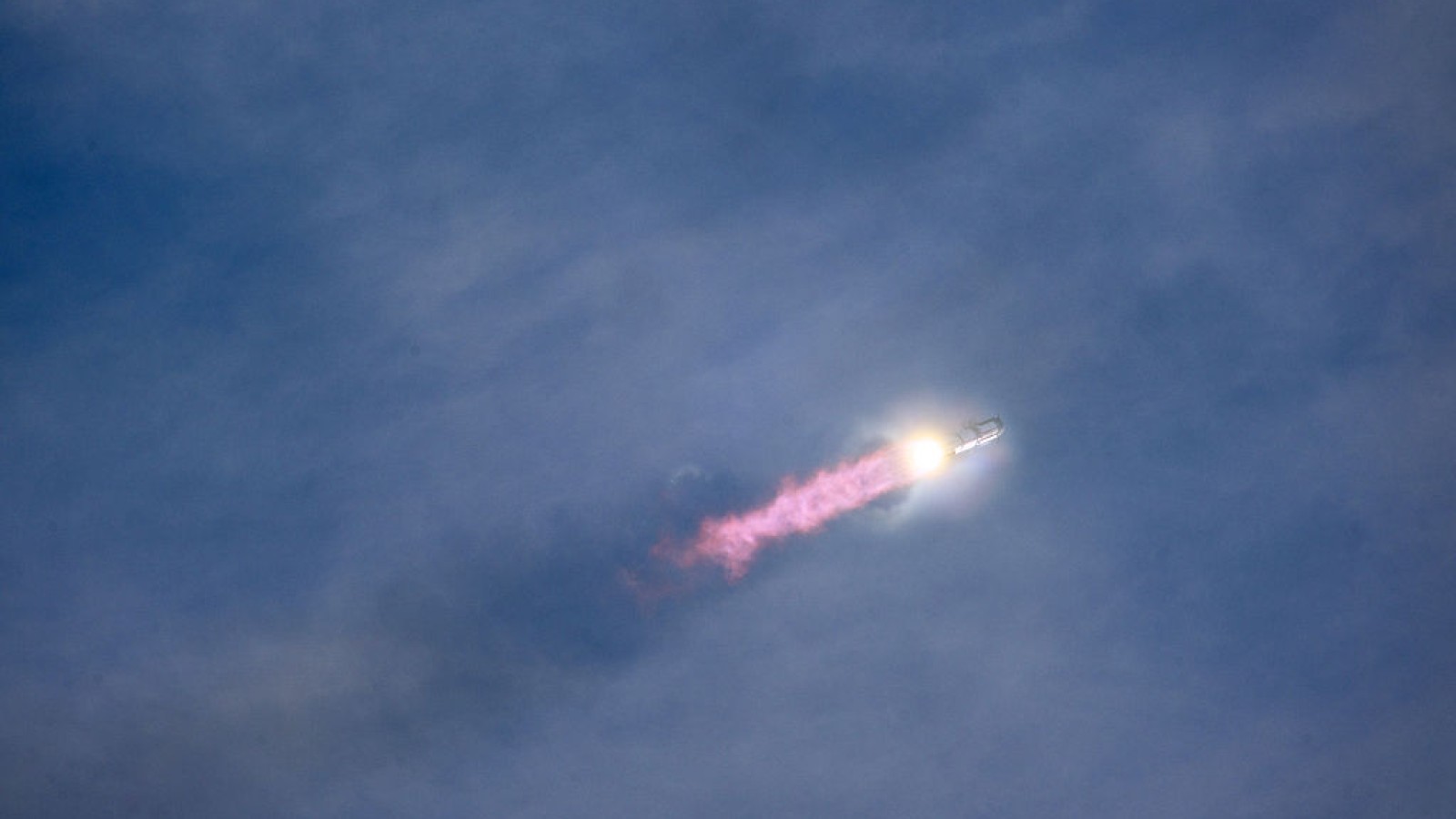
SpaceX has guided its Starship into Earth orbit for the first time, achieving the milestone despite one of its engines shutting down prematurely during Monday’s flight. In addition to reaching orbit, the vehicle deployed dozens of Starlink’s most advanced satellites.
The uncrewed mission had been scheduled to last 10 hours, covering six laps of the planet, but the control team opted to shorten the flight to three hours. Following reentry into Earth’s atmosphere, the Starship splashed down in the Pacific Ocean north of Hawaii at 11:58 a.m. ET, tipping over and bursting into flames.
The vehicle lifted off at 8:48 a.m. ET from the Starbase facility at Boca Chica Beach, Texas. This marked the 14th launch of the Starship, which, standing at 407 feet tall, is the largest launch vehicle ever designed, 44 feet taller than NASA’s retired Saturn V.
After reaching orbit, the Starship released 26 of the newest and most updated Starlink satellites, adding to the more than 11,000 already circling the planet. The vehicle reached an altitude of 170 miles and travelled at 17,500mph.
Engine Shutdown and the Path Towards Reusability
Monday’s success was not straightforward. Before reaching orbit, one of the Starship’s more than three dozen engines failed, prompting SpaceX engineers to confer for several minutes before deciding to press ahead. It was not stated whether the engine shutdown influenced the choice to reduce the flight from 10 hours to three.
Of the previous 13 Starship test flights, several ended in crashes over the Indian Ocean, some deliberately triggered by the company and others accidental. No one has ever been injured by these crashes.
The long-term ambition is for the Starship to become fully reusable in order to lower launch costs, with every component returning intact. Under the intended profile, the first-stage booster that provides lift-off thrust would return to the launch site after separating, while the Starship itself would land vertically back on Earth.
Artemis Missions and Expanding Starlink Coverage
SpaceX aims to have the Starship certified by NASA in time for the agency’s Artemis III mission, which could take place next summer. During that mission, a NASA Orion capsule carrying astronauts will dock with Blue Moon and later with the Starship. For Artemis IV, scheduled for 2028 at the earliest, astronauts will land on the Moon using either Blue Moon or Starship, with subsequent landings alternating between the two spacecraft.
The company is planning two additional launch sites: one at Florida’s Kennedy Space Center and another in Vermilion Parish along the Gulf Coast of Louisiana.
The current priority is placing further Starlink satellites into orbit, with a target of more than 100,000. The newly launched V3 satellites could be online and serving customers within weeks. SpaceX states the updated satellites provide a downlink of 1 terabyte per second, a tenfold increase over V2 satellites, along with an uplink capacity 22 times greater.